Tuesday, June 17, 2014

Mihin gets two-hour ETOPS approval


Due to a consistently excellent safety record, high standards of crew training and impeccable maintenance schedules, Mihin Lanka, Sri Lanka’s state owned low-cost carrier has obtained approval from Civil Aviation Authority of Sri Lanka for 120 minutes of Extended range Twin Operations (ETOPS). Obtaining 120 minutes of ETOPS approval has provided Mihin Lanka with access to destinations such as the Seychelles, the company said last week.
“The Seychelles is far beyond the equator on the southern hemisphere and like many other destinations, it would not have been accessible without the additional flying time provided by ETOPS. Even other routes over water between Colombo and Medan (Sumatra) and Jakarta can now be accessed,” a statement from the airline said.
Commenting on the importance of obtaining additional ETOPS flying time, Chairman/CEO, Mihin Lanka Nishantha Ranatunga stated, “The additional flying time Mihin Lanka has received reiterates the quality of the airline’s standards and procedures. This will enable Mihin Lanka’s twin engine fleet to reach new destinations in the region, which will contribute further to Sri Lanka’s growing travel and aviation industries.”

nation.lk


Monday, June 16, 2014

Thirteen planes vanish from radars over Europe

An air-safety investigation has been launched after 13 planes flying over Europe disappeared from radar screens in two “unprecedented” blackouts, leading to reports stating air traffic control systems had been hacked.
The aircraft went missing from screens across the region in early June, leaving air traffic controllers with no information about their position, direction and height – instead relying on voice communication alone.
Air traffic control centres in Austria, southern Germany, the Czech Republic and Slovakia all reported the same problem with each period of interference lasting around 25 minutes but varying from flight to flight.
Marcus Pohanka, from Austro Control, described the incidents, which occurred on June 5 and June 10 as “unprecedented,” although the authorities stressed that all the aircraft involved continued with their flights as normal.
Concerns over air safety and radar have been heightened since the disappearance of a Malaysian Airlines flight in March.
In the June 5 incident, 10 aircraft disappeared from radar screens while on June 10, a further three went missing. On each occasion, Austrian authorities brought in more controllers in order to talk with the aircraft and maintain order.
“Planes disappeared from screens for a matter of seconds, here and there. The outages were sporadic and not grave,” said a spokesman for German air-traffic control. “It must have been an external source of disruption. We are trying to identify the causes.”
Der Kurier, an Austrian newspaper, suggested that a targeted cyber-attack may have caused the disappearances. The paper also claimed the aircrafts’ transponders may have been interfered with, but that, it stresses, would have required the use of a satellite.
Eurocontrol, a European air-management agency, and the European Aviation Safety Agency have started an investigation into the two incidents.
“Given the potential impact of the incident on safety, capacity and radio frequencies the Eurocontrol Network Manager immediately started an investigation,” Eurocontrol said in a statement.
But so far experts are at a loss to explain what caused the aircraft to disappear.
At first a Nato electronic warfare exercise in Hungary was suspected as the cause of interference as it coincided.
The exercise, apparently, used devices designed to interfere with enemy radar and there were suspicions it may have affected civilian flights.
But Hungary’s defence ministry denied any Nato involvement, saying the technology used was weak and had a range of only 4,000 metres – a height well below the altitude of the aircraft.
Deepening the mystery is the fact that the second incident occurred after the exercises had finished.
Telegraph

Sunday, June 15, 2014

Civil Aviation Authority calls for report on training aircraft accident

An incident where the tyre of an aircraft used to train new pilots fell off in midair was reported on Saturday.
However, the pilot was able to land the aircraft safely at the Ratmalana Airport with the support of the air traffic control center at the airport.
The incident occurred over the Southern Expressway, when the aircraft belonging to a pilot training school took off on a routing trip.
According to the Air force Spokesperson Wing Commander Gihan Seneviratne, the aircraft that faced this bizarre incident was a Cessna-152, used primarily for flight training.
The wheel had fallen in the Paragastota area along the Southern Expressway.
Eyewitness shared these views:
“We were travelling from Kalutara to Kottawa and we entered the expressway from Dodamgoda. Five or six kilometers into our journey, we heard a plane fly past us. The tyre came loose when the plane banked left. The tyre fell on the other side of the road. A car traveling towards Galle managed to stop in time to avoid the tyre. We informed the highway security about this”.
A resident expressed these views:
“I saw a plane flying very low at around 10 or 11 a.m., I thought something must be wrong. Later I got to know that there was a tyre which came loose from the aircraft, next to the expressway”.
According to the Police Media Unit, the tyre had fallen in close proximity to the 18.9 kilometre-post in the area between Galanigama and Galle. The area comes under the purview of the Millaniya Police. The tyre of the aircraft has been taken to the Millaniya Police for further investigations.
Meanwhile, the Civil Aviation Authority has called for a report on the incident.
Director General of the Authority H.M. C. Nimalasiri noted that officials have travelled to the location and are conducting investigations.
Preliminary investigations, which were headed by the chief investigator of the authority, have already concluded.
newsfirst.lk

Sunday, June 1, 2014

Flying car to avoid traffic

An incredible flying car has been developed to let drivers skip traffic jams and take to the skies.
The vehicle can be driven on normal roads as well as being flown as a two-seater airplane, as it is able take off and land at any airport, 'opening the door to real door-to-door travel,' according to a Slovakian company.

Named the AeroMobil 2.5, the hybrid invention was unveiled at AeroTech, an airshow exhibition held in Montreal.

The vehicle has a maximum speed of 99mph when driven as a car, but in airplane mode can soar through the skies at 124mph.


mirror.lk 


The world's top A380 airports

10. Melbourne Airport
Scheduled flights: 1,710 
Number of destinations: 7


9. New York JFK 
Scheduled flights: 2,004 
Number of destinations: 6


8. Los Angeles International Airport           
Scheduled flights: 2,048 
Number of destinations: 7


7. Hong Kong International Airport 
Scheduled flights: 2,145 
Number of destinations: 9


6. Paris Charles de Gaulle
Scheduled flights: 2,613
Number of destinations: 11

5. Sydney Airport  
Scheduled flights: 2,697
Number of destinations: 8

4. Frankfurt Airport 
Scheduled flights: 3,071 
Number of destinations: 12


3. London Heathrow Airport 
Scheduled flights: 3,697 
Number of destinations: 6


2. Singapore Changi Airport
Scheduled flights: 6,653 
Number of destinations: 19


1. Dubai International Airport
Scheduled flights: 7,259
Number of destinations: 28


It costs up to $80,000 to make a business class airplane seat

A single business class seat in an airplane can cost somewhere between $30,000 and $80,000, according to a New York Times report.

That's because while airlines work to pack as many seats as they can into economy class, they're also fighting to offer the most luxurious business class options to attract high-paying passengers.

The seats themselves need to be comfortable, of course (some offer massages), but must also meet strict safety standards and be as light as possible, to reduce the plane's overall weight and fuel use.
A new seat can take three years to design and produce.

First class offerings get even more complicated, Tom Plant of B/E Aerospace, which produces seats, told the Times. With more than 2,000 components, they can cost between $250,000 and $500,000.


www.sfgate.com


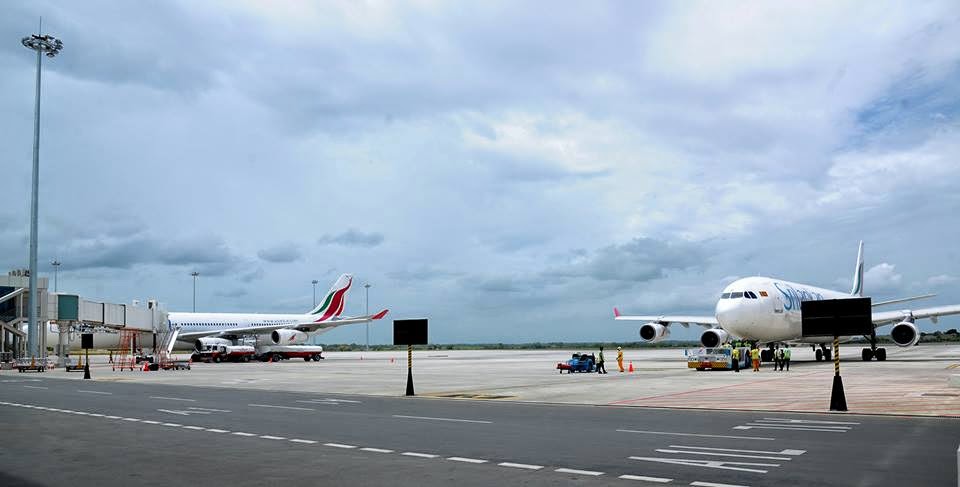
Introduction of Mattala Rajapaksa International Airport

Introduction of Mattala Rajapaksa International Airport: Mattala Rajapaksa International Airport (MRIA) (also known as the Hambantota International Airport) is an international airport serving the city of Hambantota in southeast Sri Lanka. Mattala Rajapaksa International Airport is Sri Lanka's third international airport, after Bandaranaike International Airport and Colombo City Airport. It serves as the secondary hubs for Sri Lankan Airlines and Mihin Lanka. It is named after the Rajapaksa family. It is the newest and most developing airport in Sri Lanka. It is also the first greenfieldairport in the country.

The new international airport is expected to expand the local aviation industry whilst being a catalyst for the country’s economic development enabling international trade, tourism, vocational training and employment. It is being implemented as an eco-friendly project. The airport is estimated to cost US $210 million and, by the end of construction, will cover 2,000 hectares. It is being built to be compatible with the latest Airbus A380 aircraft and has been designed according to recommendations of the International Civil Aviation Organization. According to Sri Lankan government officials, many international airlines such as Emirates (airline), Etihad Airways and Qatar Airways have shown interests in flying to Mattala HRI in the near future.
The airport is designed to facilitate for over 800 foreign passengers at peak hours and several local passengers per every 1000 km² inside the buildings. It will be made to support air-sea cargo transshipment in conjunction with the nearby Hambantota Port, which is about 15 miles away, and would act as an alternative to the Bandaranaike International Airport from the date of its completion. The Chinese government is providing financial assistance for the project. The airport is being constructed by the China Harbour Engineering Company and that is their first airport construction project ever taken. The airport is operated by Airport and Aviation Services (Sri Lanka) Ltd whom also provides the air navigation services in Sri Lanka.
The airport was declared open by the President of Sri Lanka, Mahinda Rajapaksa, on 18 March 2013 and commenced operations with the landing of a SriLankan Airlines special Airbus A340 flight named 'City of Magam Ruhunupura' with the President on board.

It handled nearly 6000 passengers in the first two months after opening. The busiest international destination is Dubai closely followed Bangkok in Thailand.

Low-cost domestic carriers Helitours and Cinnamon Air connects the airport with Ratmalana International Airport and Bandaranaike International Airport in Colombo.


Source: SriLankan Airlines Flight Academy